
📰 Newsletter
📰 Community .. What Community?
BusinessEngaged is what we call our approach to systems we are building for organisations that are ready for The Age of Engagement. It is a fundamental shift in how businesses connect, operate, and grow.
At the heart of engagement is community.
And that’s where we have a problem.
Because community has been hijacked.
Not suddenly. Not by one bad actor. This is how language always gets killed - slowly, by overuse, by laziness, by marketing departments who needed a word that felt warm and human and didn’t cost anything to say.
We know this pattern well. At PHI⑊PIN, precision in language isn’t a preference - it’s a principle. Language was one of the core tenets of People First and now in Structured Thought. Words shape how we think. Corrupt the word, corrupt the thinking.
So before we go any further - before we build, before we invite, before we grow .... we need to define exactly what we mean by community and just as importantly, what we don’t.
What does the dictionary say?
Let’s start with Merriam-Webster. 🔗 Their definition opens with:
a unified body of individuals
And then it goes on - and on. Seven sub-definitions under the first sense alone, from people living in a particular area, to a monastic community, to an interacting population of micro-organisms.
It’s not wrong. But a definition that needs seven sub-senses has told you everything and nothing.
I think the second sense gets closer to the feeling people chase:
a state or feeling of caring about and wanting to interact with others in a group
A feeling. Isn’t that what everyone is selling when they say “join our ‘community’.” The feeling. Not the substance.
And that’s the hijack in plain sight.
A Community Is
... people who need each other to succeed. And know it.
... people who recognise each other’s stake in a shared endeavour.
... where an audience knows the presenter - and members know each other.
... not where you go. It’s what you contribute to.
Community Is NOT
... an audience - they might know the presenter; they don’t know each other.
... a mailing list or database - transactional, one-directional; your community are not records.
... a membership - a card doesn’t make you known.
... your users - a relationship with a product, not people.
... your new Slack workspace even if you call it that. A channel is not a covenant.
... a networking event - connections made over coffee don’t create mutual stake.
and it certainly isn’t a room full of people having conversations, thought it might be a starting point.
A Quick Test
Do the members need each other? Not the platform. Not the host. Each other?
If yes - you might have a community.
If no - well then you might have something useful. Just don’t call it community.

The conversations are happening. The commitments are real. If you’re sensing this and already asking these questions, then you don’t need a better system - yet. You need a clearer answer to a simpler one: what are you actually trying to do?
That’s where we start.

Human By Design
My Substack is themed on the idea of ‘People First’.
I even used to call it that.
It means;
People ahead of corporations
People ahead of technology
We don’t reject either, it’s just that people are the priority.

The Age of Reason Is Over
Not yet subscribed? There’s a button for that.

Mike Maples Talking About his book Pattern Breakers …
Strictly speaking, the quote isn’t from Mike’s book, it was a comment he made about his book. I can’t quite recall where. But it resonated.

Not only that, it sparked another instalment in the ‘Structured Thought’ series. It’s arguably a bit of a detour:- less motorway, more a winding B-road through the mountains with great views over the lakes and useful terrain to explore.
Why the diversion?
Because I’ve been reflecting on responses to the earlier pieces (that have been appearing in various places across the inter webs, like here). Generally, people have loved the direction, but a few got tangled in that word ‘structure’. As if ‘structure’ was the point. And ‘thought’ a ‘decorative flourish’. So lets get this out on the table …
1] ‘Structured Thought’ is not about rigid form
It’s about thinking, questioning and making sense. And then on occasions, letting go of the structure. Entirely.
2] Success ≠ Following the Plan
Mike’s quote triggered an old favourite from Dwight D. Eisenhower ..
“Plans are useless, but planning is indispensable.”
In other words, decades before Mike and I were even born, 'Dwight' was reminding us that success doesn’t come from sticking to a perfect blueprint.
He was pointing to the importance of adaptation over strict, uncompromising structure.
Dwight was right.
And yet, in business, we still cling to structure as if it guarantees results and so we continue to roll out our plans, org charts, operating models, KPIs, governance frameworks, job descriptions, approval chains, sales methods, dashboards, checklists, project plans, gantt charts … you know what I am talking about!
The ‘Age of Reason’ Was Comfortable
During the ‘Age of Reason’, we:
measured what we could and convinced ourselves it meant something.
trusted what we could see and called it clarity.
valued what we could explain and mistook it for understanding.
built logical systems and assumed the work would follow.
ignored contradictions and rewrote the story to fit our beliefs.
For a while, it worked. Or at least, we believed it did, so we built maps and models describing what we found.
(Side thought, have you ever taken a close look at maps from medieval times?)

(Beautiful for sure - but ‘orientation’ wasn’t their prime objective. That would be ‘symbolism’. Maybe history does rhyme?)
In short, we built the illusion that we could manage complexity by taming it.
When you walk through a U.S. city and witness streets disappearing up steep hills, sometimes even stopping at a 'rock' face and then continuing at the top - all to preserve the 'integrity of the grid' and then you come to realise that the one street in town with a few gentle curves is now a tourist destination … it all snaps into place.

I would argue that we need to define what we mean by progress. Look around the world in 2025 and there are plenty of ‘unreasonable people’. I am far from convinced that they are moving us forward - which is a very common meaning of ‘progress’. But heh ho … because it gets worse.
AND … Just as we sought to tame our landscapes, we built entire industries around flattening complexity - resulting in
Books that promise 'The Ten Things Every Leader Must Do'
Methodologies claiming to ‘deliver’ and
Frameworks insisting that your success is 'just a checklist/course/YouTube subscription away' …
The real world refuses to play by those rules
But the cracks are showing. The rules have changed and the ground we’re standing on is shifting.
To Be Clear : What We Measure Should Matter
That’s not to say we throw the baby out with the bath water. No. It’s just that we need to reassess the terrain, because although we are beginning to understand that what we had and were doing is not enough, we’re still clinging on to the wrong things and applying old thinking to these new concepts. So we end up tracking what’s easy and ignoring what’s essential.
Take skills
We love to talk about the shift from hard skills to soft skills. But here’s the thing:
Hard skills are not called ‘hard’ because they’re difficult. They're called hard because they are tangible and tangible things are (relatively) easy to teach, easy to measure, and easy to stack on a résumé, so others can judge your capability. Perfect in a world of reason.
Soft skills are called ‘soft’ because they are the opposite. They are pretty intangible. When we think of soft skills we are typically viewing from the other end of the telescope and describing a feeling post outcome. They also don’t fit neatly into a spreadsheet and we certainly have no clue how to measure them properly. Like art - it’s as if we'll know 'em when we see 'em - and that's good enough …
G O O D G R I E F ... N O❗️
Hard skills come with degrees, certifications, deliverables. We know how to validate them. We built entire systems around doing exactly that.
Soft skills, like empathy, psychological safety, adaptability, active listening, resilience, humility, and trust don’t behave that way.
And this isn’t a new thought. How many times have you heard the comment that the doctor might be very skilled at what he does - but oh my - 'his bedside manner'.
Soft Skills are contextual, relational and invisible … until they’re missing. They are the invisible infrastructure of great teams. Not the structure. Not the strategy decks. They are the human glue.
But because we haven’t been able to see them, they have until now largely been ignored BUT, now that they are finally being recognised - it's getting worse - before it gets better.
They are seen as important by more and more people, BUT the ‘old school’ is still in charge. So they start by ignoring, head in the sand - until they finally accept that the dam has burst and set about managing them in the same way as they manage everything else - shoving them into old frameworks built for a different world.
Jason Fried once wrote about humanity’s natural tendency to interpret and handle something new using the mental models, processes, and constraints we already know - rather than developing entirely new approaches from scratch.
It’s why we talk about the horsepower of cars.
Why so many websites are referred to as digital brochures.
Why early television looked like filmed stage plays.
Why remote work started - and essentially remained - as 'office culture on Zoom'.
We default to the familiar, even when it no longer fits, copying the form without questioning the function - and as a result we often miss what the new thing actually makes possible.
We continue to use tools from the 'Age of Reason' to navigate the 'Age of Experience'.
I will let this one ‘marinate’ and in ‘part two’, I will pick up the thread and offer a way to move forward by designing systems that adapt, sense, and actually work in the real world. We’ll shift from recognising the problem to exploring what actually works in these modern times and discover that where structure flexes, leadership listens, and real work happens between the lines.
If you can't wait - you know where to find me. Who knows, our conversation might influence the next instalment.

The creator economy is in crisis. Now let’s fix it.
A great read that highlights the challenges of the much touted creator economy.

The Journey
People First has been a winding journey for the last four years. Most recently, I find it has been coming together in my mind very clearly and with that clarity I have been encouraged to talk about what is going on in a more open manner. The interesting thing is that as I have become more open about what I am doing, more questions are being asked.

A year ago, asking someone to sign up for the newsletter resulted in them either signing up for the newsletter - or not. No questions. No debate.
Today, I still have the newsletter , added a podcast, the book is coming out shortly and now we are beginning to create community - the questions are beginning to flow.
I still don’t understand. What is the mission/goal of the group(s)?
a newsletter reader
and
What would you say, in three or so sentences, is the hard objective of People First? Not the vague, all singing all dancing "unleashing human potential" nor the activity based "bringing like minds together" etc. What are you (and other participants) trying to tangibly accomplish? This isn't rhetorical. I am just trying to understand what will change/improve at the coal face as a result of your combined efforts.
a newsletter reader
This post is not to answer the questions ... yet. I touched on it in this weeks newsletter - and was specific about that, but here’s the good news. One takeaway for the recurring question is that people are sitting up, listening, they are interested ... which from where I sit is all good news.
As one reader wrote ...
I believe you are on the verge of an overnight success!!!
I hope he's right!
This week’ newsletter : ’A’ Future - Not ‘The’ Future
”‘Expect the unexpected’ says the social media meme. When it happened. We froze.”
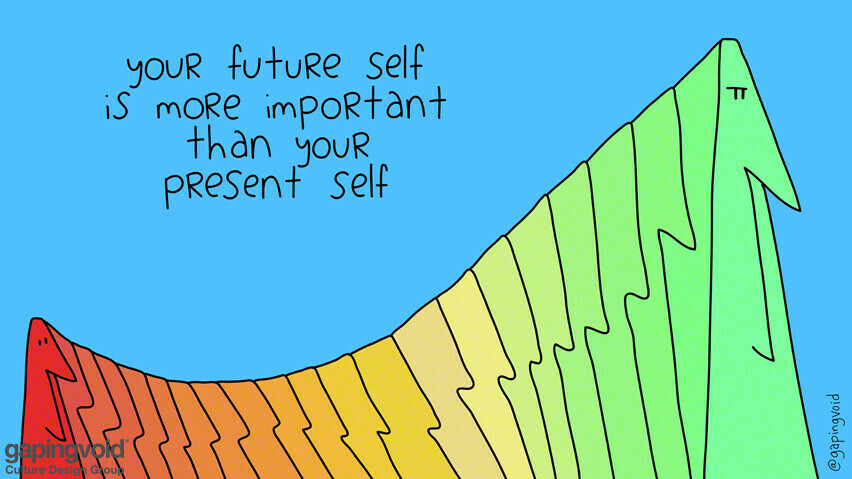
I seem to be on the same track as @GapingVoid
Now you just need to recognize that it is your future. Nobody else’s. YOURS.

The Things We Say

The Persistence of Memory - 1931
Sometimes we get so caught up in working out how to communicate across national boundaries, we forget that we can barely communicate within them. That’s why language is one of the eight tenets of People First.
Our language slowly became invested with mechanical metaphors: We needed to grease the wheels, crank up the business, dig deeper, or turn a company into a well-oiled machine. Even everyday phrases, such as “fueling up” for eating lunch or “he has a screw loose” for thinking illogically, conveyed the acceptance of humans as mechanical devices.
Douglas Rushkoff

Always Stay In Your Own Movie

One Flew Over The Cuckoo's Nest and Sometimes A Great Notion
Not Scientific - But Interesting
You could be forgiven for thinking that all of the world's problems that were top of our collective mind as we celebrated the closing of 2019 are now solved.

Louis Daguerre and Daguerreotypes
I asked a question about this image in this newsletter.

More to come, but to recognize here that it was a stretch ... First Person ... People First!
We Live In A Viral World.

There's A Perfect Storm On The Horizon
Technology?

O.M.G. Technology!
We live in the thrall of technology. ‘Shiny Things’, that deliver 'squirrel’ interruptions into our daily lives. Nothing wrong with that, with all the usual caveats that we read about. BUT …
“ OMG - Technology … all
Owned
Managed and
Governed
Not by you - but by the very companies that 'sold' you the ‘bill of goods’ to begin with. ”
John Philpin
Reflections on Reflections

I have been reflecting on the pillars of People First. Each pillar has at least one reflection that throws new light on something we might have thought we understood, but on reflection we might conclude that 'common wisdom' should be questioned.
Reflections of any subject aren't exactly true to the original. Sometimes distorted. Occasionally murky. Always the opposite of what we perceive as reality. Yet they are valid representations of reality.
Always revealing differences. Often adding new facets. To know the reflection is to understand the subject.


This is a living post and will be updated as reflections are added to the canon.
| Pillar | Reflection |
| Identity | ID - Entity |
| Data | Data? Data Is Energy! |
| Technology | Technology? OMG - Technology |

