? PeopleFirst
🚧
Thinking Allowed
This is a People First post that was originally on the People First domain. It has been moved here as part of my domain consolidation program. It’s a steady and slow WIP as I check each entry, so do please bear with me.- More about People First
- Other People First Posts
(not just from the ‘other domain’ … all of them.)
Part of an occasional series focused on the 🧶 thinking and methods. of 🧶 People First. Time will tell if it becomes something bigger like a book or ‘manual for survival’ (though that is the plan.)
Part of an occasional series focused on the 🧶 thinking and methods. of 🧶 People First. Time will tell if it becomes something bigger like a book or ‘manual for survival’ (though that is the plan.)
Part of an occasional series focused on the 🧶 thinking and methods. of 🧶 People First. Time will tell if it becomes something bigger like a book or ‘manual for survival’ (though that is the plan.)
🔗 Identity as a Product … neat idea from @dave
An identity service as a business. Operated by a strong company with longevity and a good track record for treating users and developers fairly.
Hmm - let me think who that might be?
Over on LinkedIN, 🔗 Richard Foster-Fletcher - founder of 🔗 MKAI asks
The full piece is here
I started to reply and of course LinkedIN gave me its usual ‘too long’ message … hence the post. (Those that follow me, might recognize some of the arguments.)
My Response
Yes we do need to rethink work-life balance … and we should start by scrapping the concept entirely. I doubt Ed Sheeran (to pick a random name) worries about his work-life balance? Or anybody who is doing what they love and getting paid to do it for that matter.
The problem is that for most people ‘work’ is not a passion, or love … it is the means to an end of building income that then allows them to follow their passion. Remember ‘hobbies’? Remember ‘holidays’? Remember retirement? … all constructs that allow people to take a break from ‘the machine’ and do what they really want to do.
Work-Life balance is one of those. It is only needed in a world where the work part is not your dream, passion, love …. So bring on the AIs and let them pick up the drudgery of our work lives. Let people move on to thinking and doing things that they consider meaningful and love and have a passion for.
Of course, this Utopia is destined to fail, without significant changes in the social fabric of society.
Take a look at what most musicians, artists, writers (insert the thing you really love and want to do) actually earn and quickly realise that they don’t make a living, much less a good one. Now imagine doubling or trebling the number of people trying to earn a living in that way .. and ask yourself if X million people currently struggle to make a living, how 2X or 3X are going to do that?
Bonus question. When will corporations stop thinking of customers and staff as two distinct ‘audiences’, and realize that they are all connected, starting with the fact that they are all people. As more companies shed people from their books through automation, outsourcing, off shoring and now (apparently) AI, they get to produce more and more things for customers to buy at less and less cost. Thats the ‘maximizing shareholder value’ bit.
Last time I looked, the buying power of the robot market was non existent - primarily because they don’t get paid for the work they do. As ‘the machine’ replaces more and more people by ‘machines’, there will be less and less people earning income to buy the stuff that the corporations are producing, it doesn’t matter how good their product is … nobody can buy it, even if they want to. Then what?
This is why asking what the future of work looks like is asking the wrong question.
BTW - Richard hosts an excellent salon under the umbrella of MKAI, hit me up if you would like to join - and I will connect some dots.
The Antidote To Worldcoin
and then there is this ….
… she’s talking about Sam Altman
🔗 You can read the whole piece by Molly here, which includes substantial thinking on the challenges of decentralized identity.
The cryptocurrency industry is rife with projects that embrace the idea of “progressive decentralization”: beginning out as a highly centralized project run by a small group, but promising to eventually turn over control of the project to a DAO. Few ever follow through,10 but it is a convenient way to stave off criticism.
💬 Molly White
In my same ‘reading session’ this piece from my friend Alan Mayo : The Reasonable Future: Identity 2.5 appeared. He concludes;
Some of the world is hell-bent on achieving Identity 3 Decentralization and, ironically, this is not going to happen anytime soon. With our current proven technologies we have all the building blocks to build sophisticated Identity solutions that provide a good customer experience and good security. That is where we should be spending our time, rather than dreaming of an impossible future.
💬 Alan Mayo
The Antidote?
Stop listening to people who are playing both sides of the ‘Business Equation’ - even better … stop acting on their recommendations. Altman isn’t the only one.
This is a 🧶 People First post - to see others in the series, click here.
🎛️ The Future Of Income
Over the years I have used different words, different ’lenses’, different ‘glasses’, ‘filters’ - but it all comes down to this.
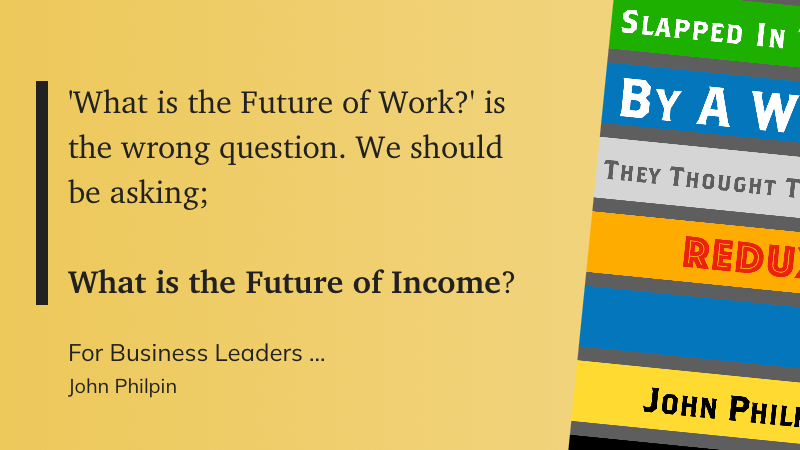
And too quickly I am told that ‘UBI’ is not the solution, to which I point out that I never said it was. Delighted to hear David Wood making exactly the same point. He goes on …
what is happening is not business as usual.
I agree.
The Full Podcast:
🎙️ David Wood Talking On David Brown’s Podcast