
? PeopleFirst
🔗 A List of AI Links
Like a lot of us I guess - I have been reading and listening a lot to the AI chatter. This is a list of not everything I have read and listened to - and not quite sure why these ended up on a list and others didn’t - but still you might find an interesting nougat in here?
My last 🔗 Travels Without Charley makes for a short, thoughtful read.
Thinking Allowed
This is a People First post that was originally on the People First domain. It has been moved here as part of my domain consolidation program. It’s a steady and slow WIP as I check each entry, so do please bear with me.- More about People First
- Other People First Posts
(not just from the ‘other domain’ … all of them.)
Am I missing a step with webmentions?
🔗 A recent post on People First was syndicated to Micro Blog.
I replied to that post in MicroBlog.
And it seems to be approved

So, shouldn’t it appear here?
🇳🇿 Small Businesses in New Zealand - And Elsewhere
The particular comment I was responding to was in a private group hosted in New Zealand - hence the opening paragraph. BUT - I think it pertains to any country. In that post, this link was provided — I think New Zealand has more businesses (and hence ‘small’ businesses) per capita than pretty much any New Zealand just doesn’t have the people to support it.
BUT - when you leave New Zealand … there has been something happening for a while now. I will try to discover the article I wrote a while back ….
Here’s the nub … In the US (but I am pretty sure this applies to most countries) 50 to 60 years ago, big employers like GM and GE were the dominant market cap companies on the financial exchanges. Not entirely un-coincidentally, they were also the companies that employed the most people. Fast forward to today … the market caps of the biggest companies are an order of magnitude higher than the ones back then and the number of people they employ is an order of magnitude less. Meanwhile the population of America has doubled? Tripled?
So where are all those people now working? Answer small … or at least smallER businesses.
Some of this has been achieved by improved efficiencies … we no longer need banks of people directing calls, typing up documents, manufacturing cars …. But also … since the 70s there has been a steady drip of those organizations getting those people ‘off the books’ .. why employ people if you can off shore, outsource, automate processes … and the new one - use AI. The result is that more and more people are in smaller and smaller businesses but often working in service to a larger organization.
Quite simply - If I am building a house (actually - or metaphorically) .. do I employ everyone full time … or contract with the right resources at the right time to get the job done?
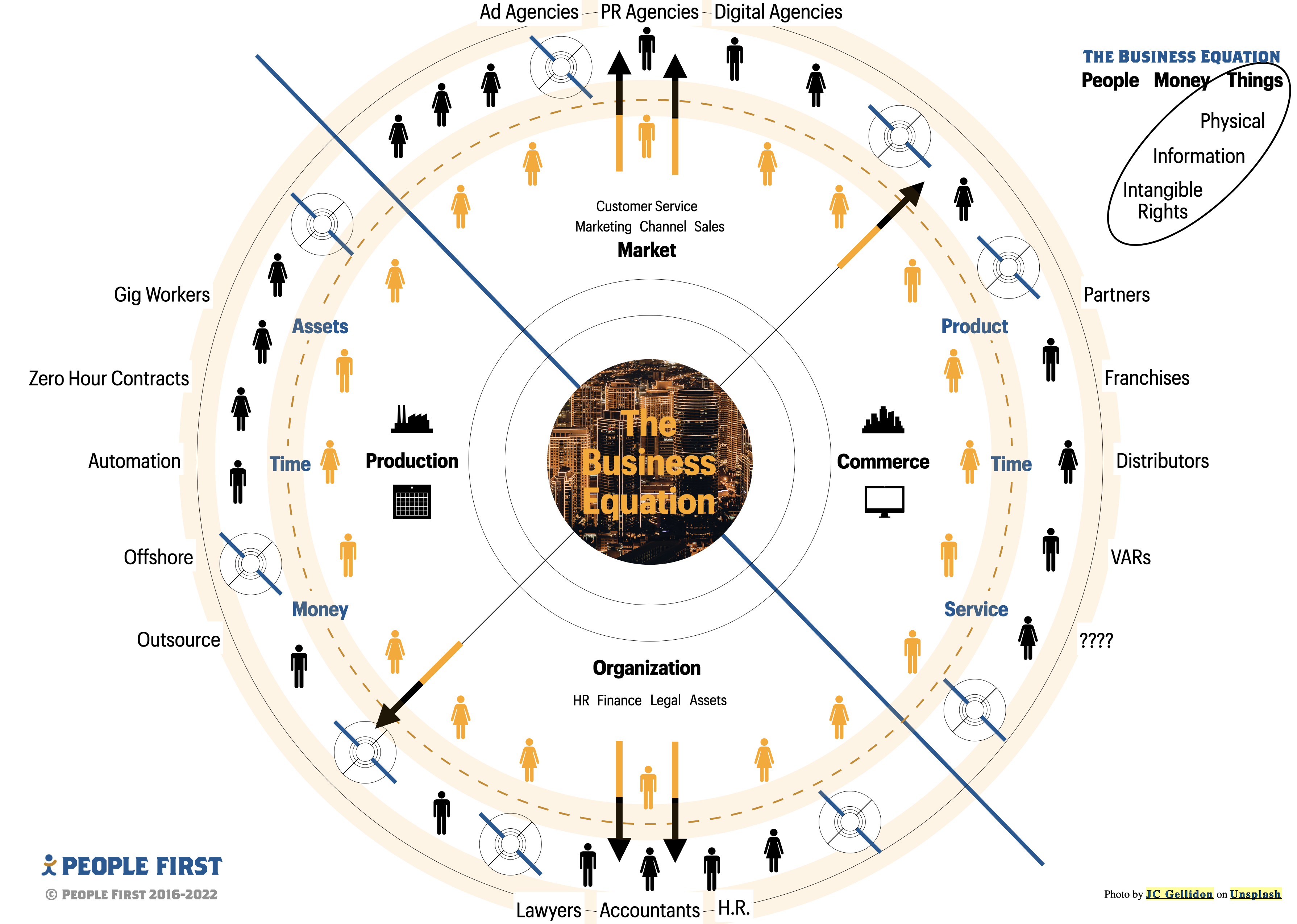
Tongue in cheek .. but for the longest time, I have had this vision of the ideal company comprising a single individual with ‘agents’ managing their ‘virtual supply chain’ that they need to deliver value to their customers.
This thought informs the graphic below - 'The Business Equation' - and is foundational thinking in the People First domain.
🔗 Clubhouse is laying off more than half of its workforce - The Verge
Quel surprise … I wrote this when I was still on the wait list … and once in I even guested on a couple … my one word summary of the experiences, the site, the conversations, the quality … ‘crap’.
Ten things that you can do to embrace the future of AI whilst mitigating the threat of losing your liveliehood.
1. Stay informed: Keep up-to-date on the latest developments and trends in AI and automation, and how they are affecting your industry and job market.
2. Develop new skills: Continuously learn new skills to stay relevant in the job market, such as programming, data analysis, or other skills related to AI.
3. Pursue higher education: Consider obtaining a degree or certification in a field related to AI, such as computer science or data science, to prepare for the jobs of the future.
4. Explore new career opportunities: Look for opportunities to work with or alongside AI, such as in fields like robotics, automation, and machine learning.
5. Be adaptable: Embrace new ways of working and be open to adapting to changing work environments as AI and automation continue to transform the workplace.

6. Build a strong professional network: Connect with other professionals in your field and seek out mentorship and guidance to stay up-to-date on the latest developments in AI.
7. Be creative: Explore new ways of applying your skills and expertise to stay ahead of the curve and capitalize on emerging opportunities in the AI economy.
8. Consider entrepreneurship: Starting your own business or pursuing self-employment can provide greater control over your livelihood and allow you to take advantage of emerging opportunities in the AI economy.
9. Advocate for policies that support workers: Encourage policymakers to create policies that support workers and address the potential negative impacts of AI on employment, such as job retraining programs and income support for displaced workers.
10. Stay positive: Embrace the potential benefits that AI can bring, such as increased productivity and efficiency, and stay positive about the opportunities that lie ahead.
Ten things that corporations can do to empower their employees and their use of AI whilst NOT reducing their workforce to increase profits.
-
Invest in upskilling and reskilling: Provide opportunities for employees to learn new skills and develop expertise in areas related to AI, such as data analysis, programming, or robotics.
-
Foster a culture of innovation: Encourage employees to experiment with new technologies and processes, and provide the resources and support necessary to implement new ideas.
-
Promote collaboration: Encourage cross-functional collaboration and knowledge sharing, to bring together employees from different departments with diverse skill sets and expertise.
-
Ensure transparency and communication: Be transparent about the company’s AI strategy and communicate clearly with employees about how AI is being used and how it will impact their work.
-
Emphasize ethical considerations: Ensure that AI is being developed and used in an ethical and responsible manner, and prioritize the well-being of employees and society as a whole.

-
Implement AI for augmentation rather than automation: Use AI to enhance human decision-making and productivity, rather than replacing human workers with automated systems.
-
Prioritize employee well-being: Consider the impact of AI on employee well-being, and take steps to mitigate potential negative effects, such as stress or burnout.
-
Encourage employee feedback: Solicit feedback from employees on how AI is being used and how it could be improved, to ensure that employees feel empowered and engaged in the process.
-
Reward creativity and innovation: Recognize and reward employees who come up with innovative ways to use AI to improve the company’s operations or products.
-
Invest in long-term goals: Focus on the long-term benefits of AI, rather than short-term cost savings, and invest in initiatives that will create sustainable growth and benefit both the company and its employees over the long term.
🎛️ Whats good for the Goose is good for the Gander
13 seconds that neatly encapsulates the People First challenge. Maybe AI will finally push open the flood gates
The Full Podcast:
It’s been a while since People First released a newsletter - just put that to right.
䷓ Glossary Terms
Slowly building up my glossary links ( thankyou @AndySylvester ) … 4 active so far … more in the background - and none of the embedded terms are yet implemented (except that one at the bottom of this post). None of the click throughs are final text yet - but that is kind of the beauty of the 🔗 glossary.
Learn more about People First.
An experiment as I think about moving peoplefirst.business into MicroBlog.
About my position on The Future of Work.
The glossary allows me to set one or more fixed footers on any post that are generated dynamically, so if I want to change anything - I change it once and it changes everywhere. This is an example of such a footer.