
🖋️ LongForm
Want to reduce the noice and just focus on things with a little more meat - the this category is for you. Like so much on this site we have a ‘WIP’ as i take some out - and put some in - but safe for at least starting in 2026.

Open AI Announcement
“We’re excited to announce the release of the newest addition to the GPT-3 model family:
text-davinci-003. This model builds on top of our previous InstructGPT models, and improves on a number of behaviors that we’ve heard are important to you as developers.”
💬 Open AI
So of course I had to go try ….
The Prompt
Please write 4 paragraphs about Stop Child Traffic Foundation which is a non for profit organization that responds to refugee crisis, and uses technology and innovation to prevent harm to vulnerable populations like refugees and women and children.
The Response
_The Stop Child Traffic Foundation (SCTF) is a non-profit organization that works to prevent harm to vulnerable populations such as refugees and women and children. The foundation works to ensure the safety of these vulnerable populations by responding to refugee crises and using technology and innovation to prevent their exploitation. The foundation was established in 1999 and is based in London.
The SCTF works to protect vulnerable populations by responding to refugee crises and using technology and innovation to prevent exploitation. The foundation works with governments, non-governmental organizations, and other partners to develop innovative solutions to address the exploitation of vulnerable populations. The foundation focuses on prevention and early intervention, such as identifying and responding to cases of trafficking and exploitation. This includes providing support and resources to vulnerable populations and raising public awareness of the issues.
The foundation also works to improve the lives of vulnerable populations by working with partners to develop innovative programs and services. This includes providing access to education, healthcare, and employment opportunities. The foundation also works to ensure the safety of vulnerable populations by advocating for improved legislation and policy, monitoring human rights violations and supporting legal aid for vulnerable populations.
SCTF has achieved many successes including the launch of the first online platform designed to enable vulnerable populations to access resources and support._
The words aren’t QUITE right - but as a straight out of the box summary of the Stop Child Traffic Foundation - I am seriously impressed.
PS - More about Stop Child Traffic to come.
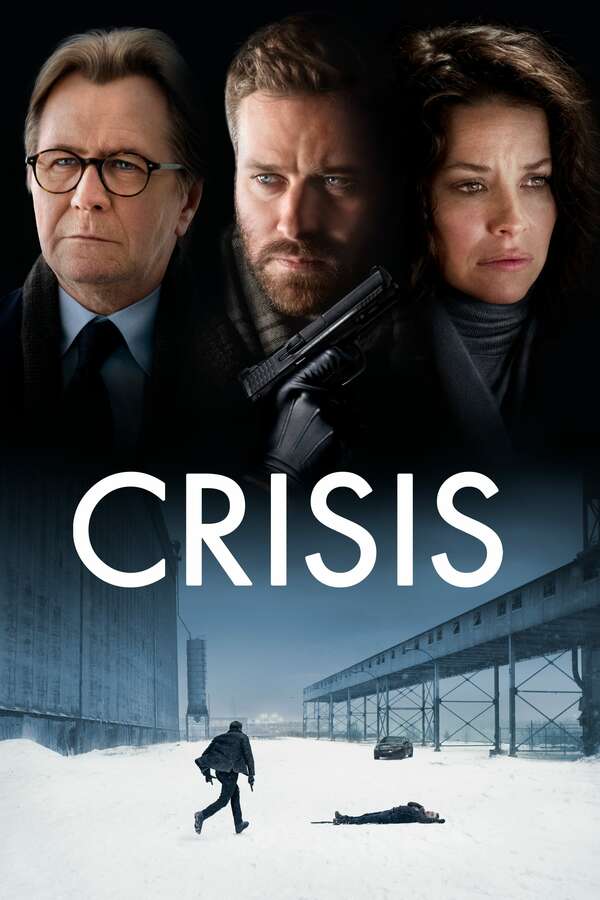
🎥 Lesson Plan, 2022 - ★★
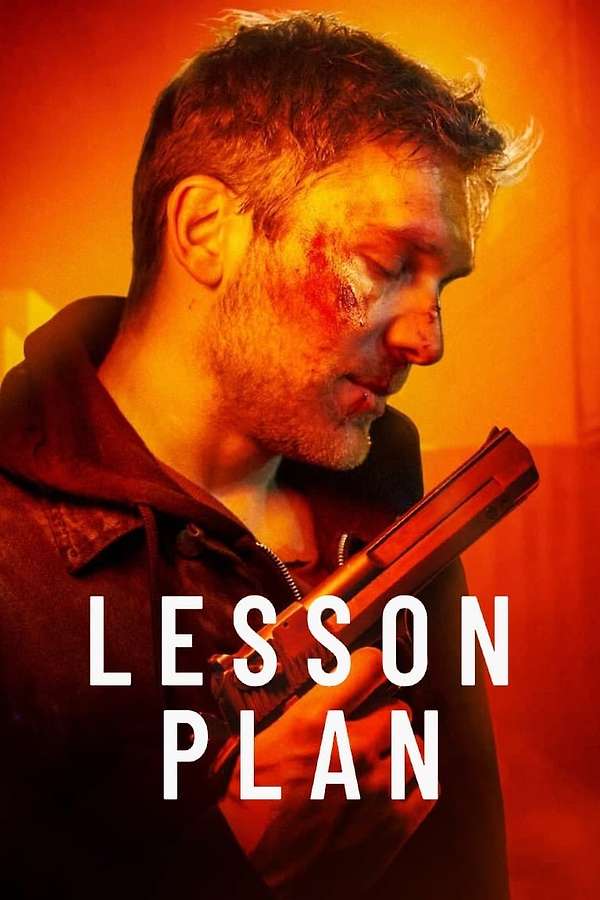
I know that there are only 7 stories in the world. My question is why is this the one that keeps getting told - and then badly. In fairness, I got to the end, so it wasn't a total dud, but if you want to watch this story sometime, choose a different movie.
Ghost Reader Is Solving A Problem That A Lot of A.I.'s Don't Seem To
A lot of AIs seem to be focussed on how to create. new things, the interesting thing that Readwise is up to is that they are focussed on using AI to better understand what is already there ….. I think that is an interesting problem to solve.
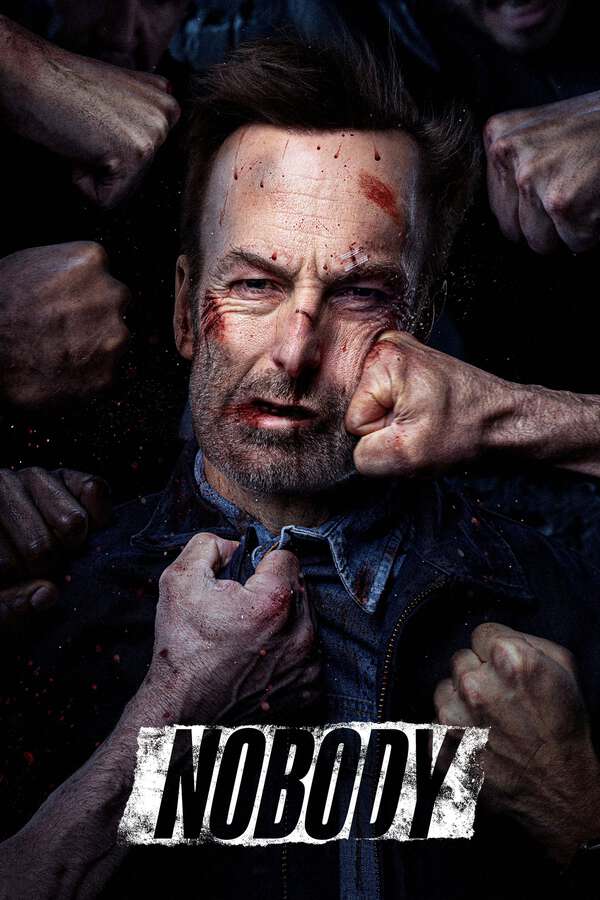
🎥 Slumdog Millionaire, 2008 - ★★★½
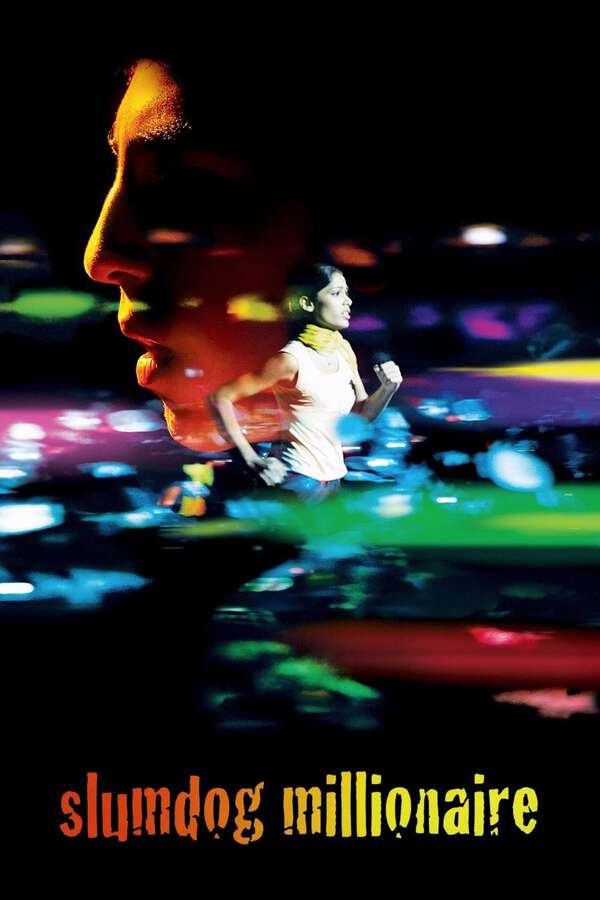
Probably one of those times where the film could never live up to the expectations … and yes it’s taken me 15 years to watch it! It was ok .. but for me the best part was the dance on the station platform at the end!
What You Remember Isn't Always What Happened.
Some context to this post, because it really isn’t just about memory (that’s the back story). It is really setting the scene for what I think will be a series of posts that I will link to from here that is exploring whether Geoffrey Moore’s chasm thinking can be applied to a country. Still not sure it can - but we will see as the journey unfolds.
Why Don't We All Have Agents
I got a voice mail from my agent this evening. She opened with her usual apologies for being out of touch but she wanted to talk to me about four contracts that were coming to a head. Details needed to be nailed down.
Four contracts? I knew about the transformation contract, but as for the other three … I had no idea what she was talking about. What else had she found?
Color me intrigued.
Of course I called her back and she dived in head first, at her usual ra ta tat tat machine gun conversational speed … and I listened - I mean what was my choice!
.. and to find out what happened then … well we have a podcast for that … a short one mind you … 6 minutes and 41 seconds.
A MicroBlog Enhancement Request
I like that micro blog can be used as an rss reader and a mastodon reader and a microblog time line reader and ….
BUT
I wonder what code change would be needed to allow me (the reader) to filter my timeline on (say)
- mastodon only
- blog site rss only
- Microblog only
- etc etc
Currently I am unfollowing every Mastodon account in Micro Blog that I have historically followed - and picking them up in Mastodon.
I have never followed a web site in MB
I follow
- RSS in NetNewsWire
- All Substack Newsletters in Substack app
- All other newsletters in StoopInbox
This is because I think understanding where the post emanates contributes to me understanding more of the context.
I get the beauty of having everything coming in to a single place - and sometimes that would be good - but not always.
Podcasts. You Need A Player AND Something To Listen To.
Interesting that it isn’t just Mastodon that seems to be in sudden growth mode. The Mastodon questions relating to ‘how to get started’ and ‘who to follow’ are just as applicable to Podcasts - even though they are much more established. That said, it is clear that even for the long time listener, checking in and making sure that once you have found the best stuff to listen (often by asking around) that you have the best stuff to listen to it on!
This post then is my contribution to answering;
🔸 What is the best app?
🔸 Which podcasts should I follow and why?
Caveat - I am an Apple ecosystem person - so my podcast player recommendations MIGHT not be available on your platform of choice. Sorry.
Which Player
As an Apple user, you might expect me to use the Apple player and you would be wrong. Every now and then I do revisit Apple’s core apps to make sure I have a good reason to be outside of their ecosystem. I last checked the Apple podcast world 3 months ago. NOPE.
Not to say it isn’t a good app - its just that it doesn’t work for me and this is primarily because I follow to a LOT of podcasts and listen to very few of them. As a result, I need an easy mechanism to find, categorize, triage, organize and listen.
There are few apps that I haven’t downloaded, most don’t work for me (or more accurately, they don’t offer enough to make me want to switch). They might work for you - all good, this isn’y the kind of piece to get into that debate.
This is what I use and why it specifically works for me.
I have used Castro for a long time. It really is a wonderful app and I would not knock it. Castro and Marco Arment’s Overcast are the two podcast apps that I kept coming back to when I looked outside of Apple. When I first explored podcast apps beyond Apple, I tried them both. Castro won out. I just couldn’t get my head around the way Overcast worked. Castro in comparison was very intuitive. Why relearn when what you have works?
And then 3 months ago that all changed. As I referenced above, I do explore app alternatives from time. Changes had been made to the Apple app - so i explored and hadn’t realized that Overcast had itself been through a massive redesign.
Oh my.
The Apple changes were good - but nothing that helped me. BUT Overcast won out and I have been using it ever since. This is why.
I subscribe to over 100 podcasts (don’t judge me) and generally listen to a podcast for somewhere between 30 and 90 minutes each day. It does get over 90 minutes from time to time - mainly depending on what else is going on in my life. Clearly there is lot that I follow and don’t listen to. So as I wrote above when looking at a podcast app, find, categorize, triage, organize and listen are all important functions.
My Process
-
Every single podcast I follow is categorized into one or more place … ‘tech’, ‘politics’, ‘bbc and npr’, ‘humour’, ‘music’ … you get the picture.
-
As part of my morning ‘feed catchup’ i triage all the new arrivals and delete anything I know I won’t be even thinking about listening to.
-
When I am ready to listen - the category filter helps me do an initial narrow down and then I choose from within.
Resultant Benefits for me. (Your mileage may vary)
🔸 Very intuitive
🔸 Fast and efficient triage
🔸 Synching across multiple devices
🔸 Their app even works on the Mac
🔸 The Ability to categorize to quickly choose ‘the tone’.
The Unique Controls in Settings I won’t go into - suffice to say, the possible refinements of what you MIGHT choose to do is extraordinary - but were I to tell you that I have not changed one setting - you would know that this app is very much in synch with how I think.
Through all of this you will notice I have made no mention of speeding up / slowing down podcasts (which is possible in most players) - because I don’t do it, even with the sheer number of shows I triage. I was tempted once, tried it, didn’t like, never bothered again. To me, it is similar to reading a book’s cliff notes and assuming you have read the book.
What I Listen To
At any given moment I might have up to 40 unplayed podcasts in the queue. (Right now I am at 21, I know because I just counted. In fact - well - here they are.)
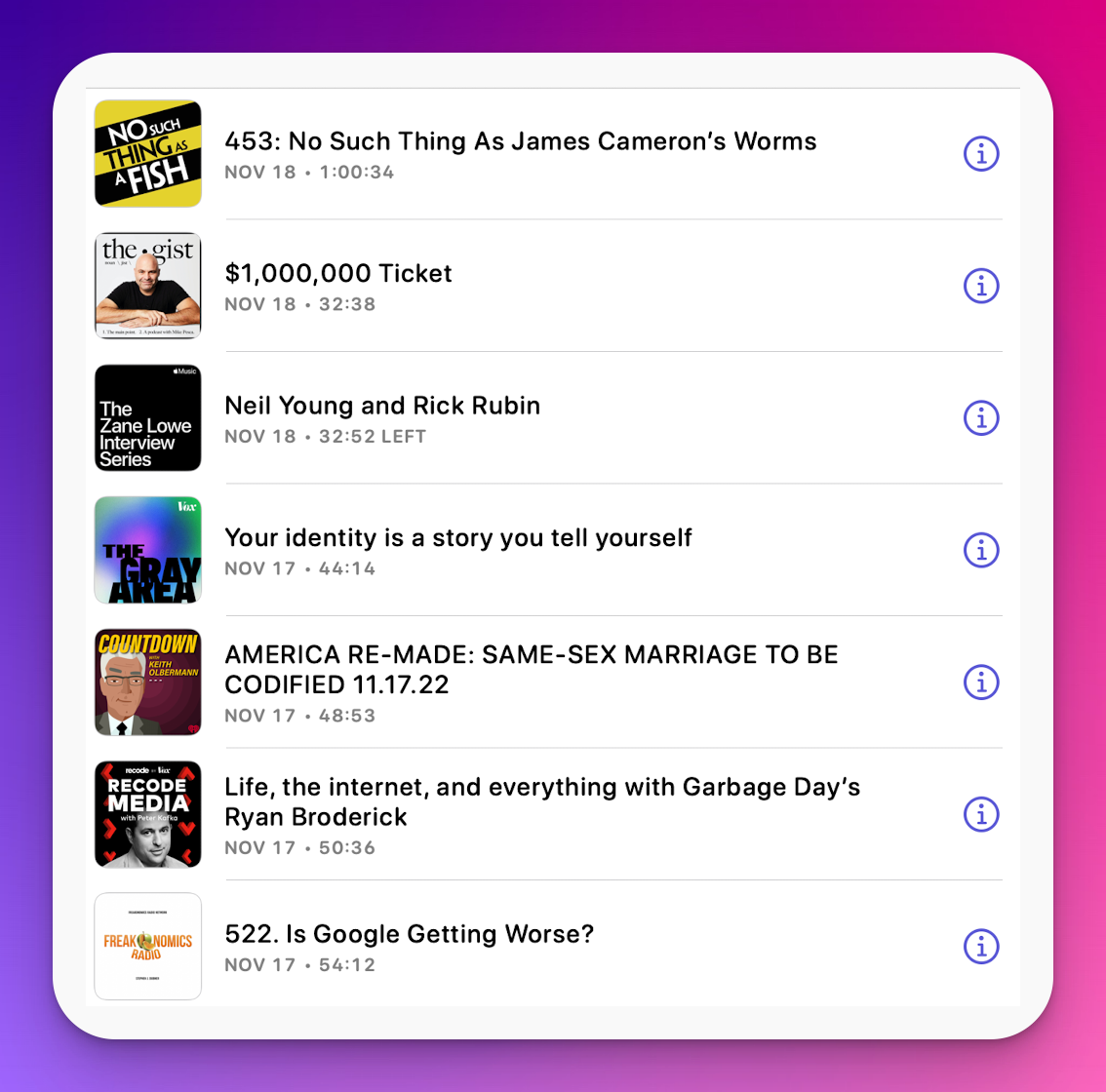
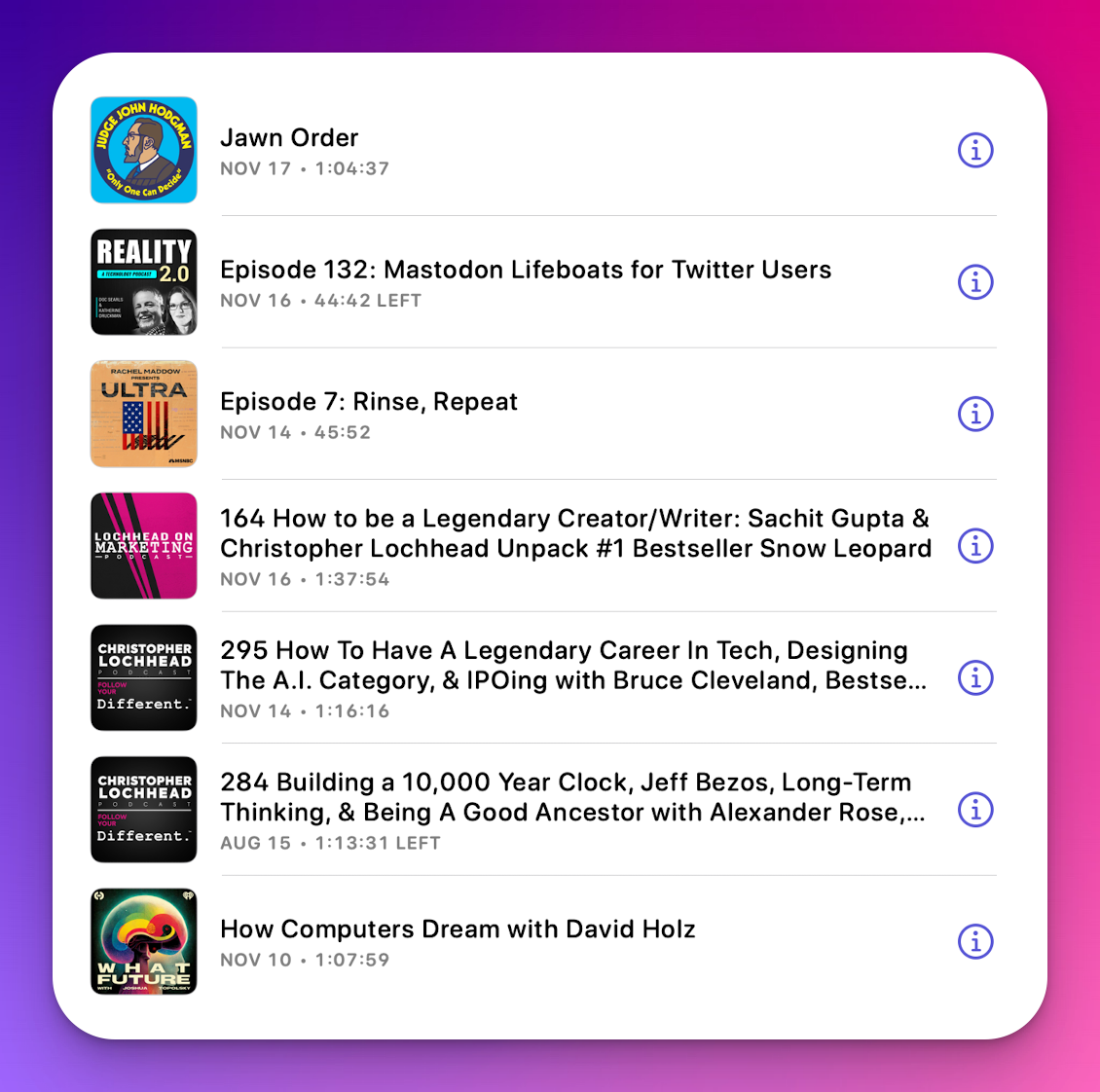
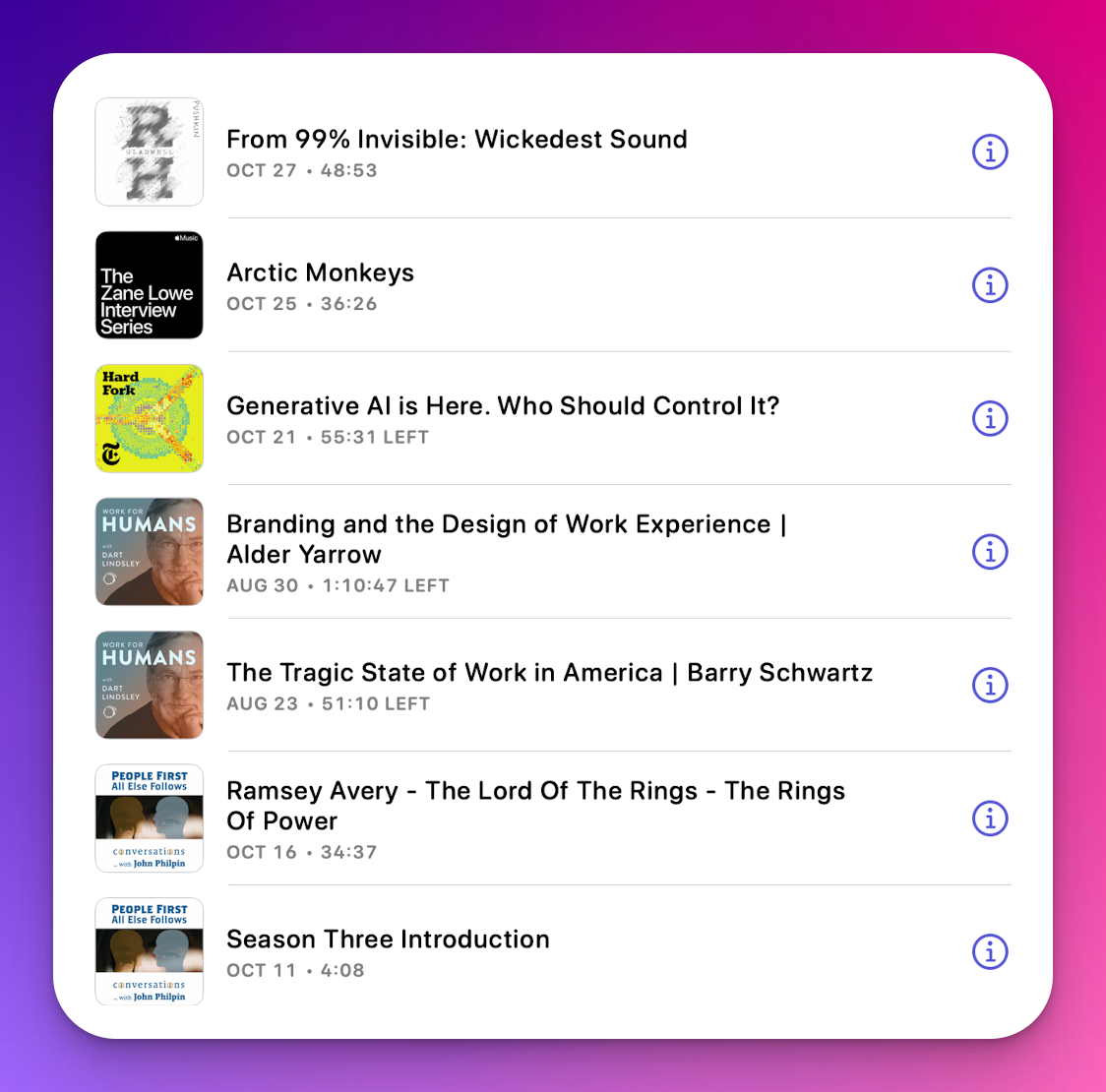
Some shows I simply have the latest version of ready to go if I feel inpired … No Such Thing, The Gist, John Hodgman being good examples.
Other shows, like Zane Lowe and Rockentours might have multiple episodes - because I really want to hear the guest. Example below - note that Zane Lowe has two shows in the hopper, Chris Lockhead has THREE. But - will I really get round to listening nearly 5 hours of Lockhead - just across these three shows - probably not, so over time they wil get removed without listening.
And finally - you will see that two of my twenty one shows are my own podcasts. Yes I do listen to them once they are published and I keep the latest Season in the Inbox for easy discovery if I need a link for someone. Season Three just kicked off - so only two shows so far.
Recommendations
So what shows would I specifically recommend? Well again - the point is what are you interested in? If I knew that, I could be of more help, so I reduced the list to a solid personal 10 - which are in no particular order, but if I know what kind of stuff you like - I probably have a view - with the exception of Sports!
🔸 Chris Lockhead and Category Pirates - marketing and business
🔸 Rob Long - 15 minutes of delight
🔸 Peter Kafka - media meets technology
🔸 Rockenteurs - a music podcast rom Gary Kemp and Guy Pratt
🔸 Zane Lowe - music
🔸 Sam Harris - for quiet relfection
🔸 John Hodgman - he’s just funny
🔸 Ezra Klein - considered thought, good guests
🔸 Mike Pesca - The Gist - a daily ‘news’ show from an ex PBS presenter
🔸 People First - my own People First podcast
That’s it - do you have any recommendations and thoughts?
Sad To See A Small Company You Know Declare Bankruptcy
No names - no pack drill to protect the innocent, but prompted to write this because while it is sad, I don’t like history to be rewritten.
The official statement reads that it has declared bankruptcy because of “poor economic conditions since Covid and increased costs and delays associated with expansion plans.”
Sure - and - it was clear when I talked to them that the company had a difficult route even before Covid. Capital investment needed was massive to deliver the physical spaces needed to conduct the business, meanwhile the funding being raised was easily an order of magnitude too little to deliver on the promise.
Covid might have accelerated the demise but it was plain for anyone to see with even a tad due-diligence, which continues to remain in short supply.
Not only that …
“The group had one facility and was in the process of setting up two larger ones in xxx and xxx, while also developing an online app that would …..”
It’s over 2 years since I last talked to them - but at that time they were ‘working on an app’. How long does ‘an app’ take?
🎥 The Batman, 2022 - ★★★½
I'm a sucker for Batman. Not the best and so DARK ... not the storyline, the cinematography. At times just watching a black screen. Probably more a commentary on the TV than the movie, but still...
I guess if they are trying to get us back to the movie houses... It makes sense?
🎥 Enola Holmes 2, 2022 - ★★★½
Having watched ‘round 1’ … I knew what to expect and I wasn’t disappointed.